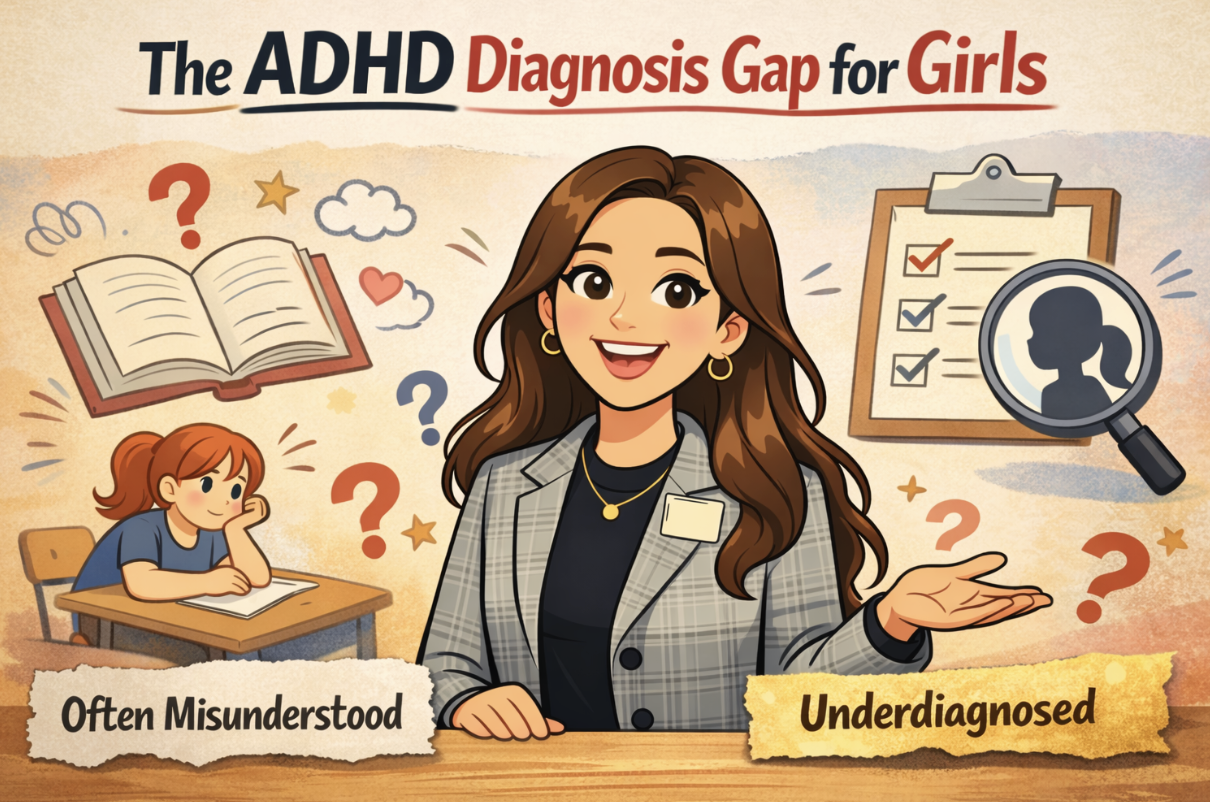
"Unfocused." "Unmotivated." "Lazy."
I was the standard case. My ADHD matched the exact symptoms doctors were trained to recognize. I fit the "model" of what a young child with ADHD was supposed to look like.
But for many girls, this isn't the case.
Instead of being recognized, many girls are dismissed. For generations, girls have heard echoes of these labels in classrooms and at home, reinforcing stereotypes instead of prompting questions about what might be going on beneath the surface. What begins as an observation becomes a label. Over time, many girls grow up believing their struggles are simply their fault — not something that can be explained or supported.
ADHD isn't rare for girls. Being recognized is.
ADHD is one of the most common pediatric behavioral health conditions, affecting nearly 6 million young people in the United States. And yet, girls are frequently left out. So, why is ADHD so often missed in girls?
For decades, ADHD was viewed as a "boys' disorder." As Stephen Hinshaw, PhD, chair of psychology at UC Berkeley has explained, early research and diagnostic frameworks were built almost entirely around male patients. In 2026, we now know this research was incomplete. But for far too long, it shaped how ADHD was taught, diagnosed, and treated.
When ADHD is quiet, it's easier to miss. Girls with ADHD are more likely to show inattentive symptoms — such as difficulty sustaining attention, disorganization, and forgetfulness — rather than hyperactivity or impulsivity. Because inattention is quieter and less disruptive, it often flies under the radar of parents and teachers.
As a result, fewer girls are referred for evaluation, even when they're struggling. Being overlooked isn't a reflection of how severe ADHD is in girls — it's a reflection of how narrowly we've learned to recognize it. And that gap between experience and understanding is where many girls are still falling through.
Being overlooked isn't a reflection of how severe ADHD is in girls. It's a reflection of how narrowly we've learned to recognize it.— Dylan Tanzer
The good news is that this story is beginning to change. As awareness grows and conversations widen, more girls are being seen for who they truly are. Not lazy or unmotivated, but navigating a brain that works differently. With earlier recognition and better understanding, girls with ADHD can gain something powerful: clarity, support, and the freedom to stop blaming themselves for struggles that were never their fault in the first place.
Girls with ADHD deserve to be seen.
More coming soon.
Want to go deeper on this topic?
In Season 1, Dylan sits down with psychiatrists and neuropsychologists to talk about ADHD diagnosis — what it really looks like, and what parents should know.
Watch the Series →Child Mind Institute. How girls with ADHD are different. childmind.org
CDC. Data and statistics about ADHD. cdc.gov
Hinshaw, S.P. (2022). ADHD in girls and women. greatergood.berkeley.edu